

Are Your Garage Doors OSHA-Compliant?
Key Takeaways
1. OSHA-compliant garage doors are really about risk control: the door operates safely during normal use, and known hazards aren’t ignored.
2. The best way to reduce injury risk and OSHA exposure is to treat a failing door as a hazard: stop use, secure the area, and fix it fast.
3. Raynor Door Authority helps you stabilize operations fast with 24/7 emergency repair support.
What “OSHA-Compliant” Means for Commercial Garage Doors
Your garage doors are OSHA compliant if they don’t create predictable injury risks during normal operation and maintenance. There’s no single certification or label that makes a door “OSHA-approved,” but compliance means your door system, safety features, and workplace practices meet OSHA’s general duty standards for protecting employees.
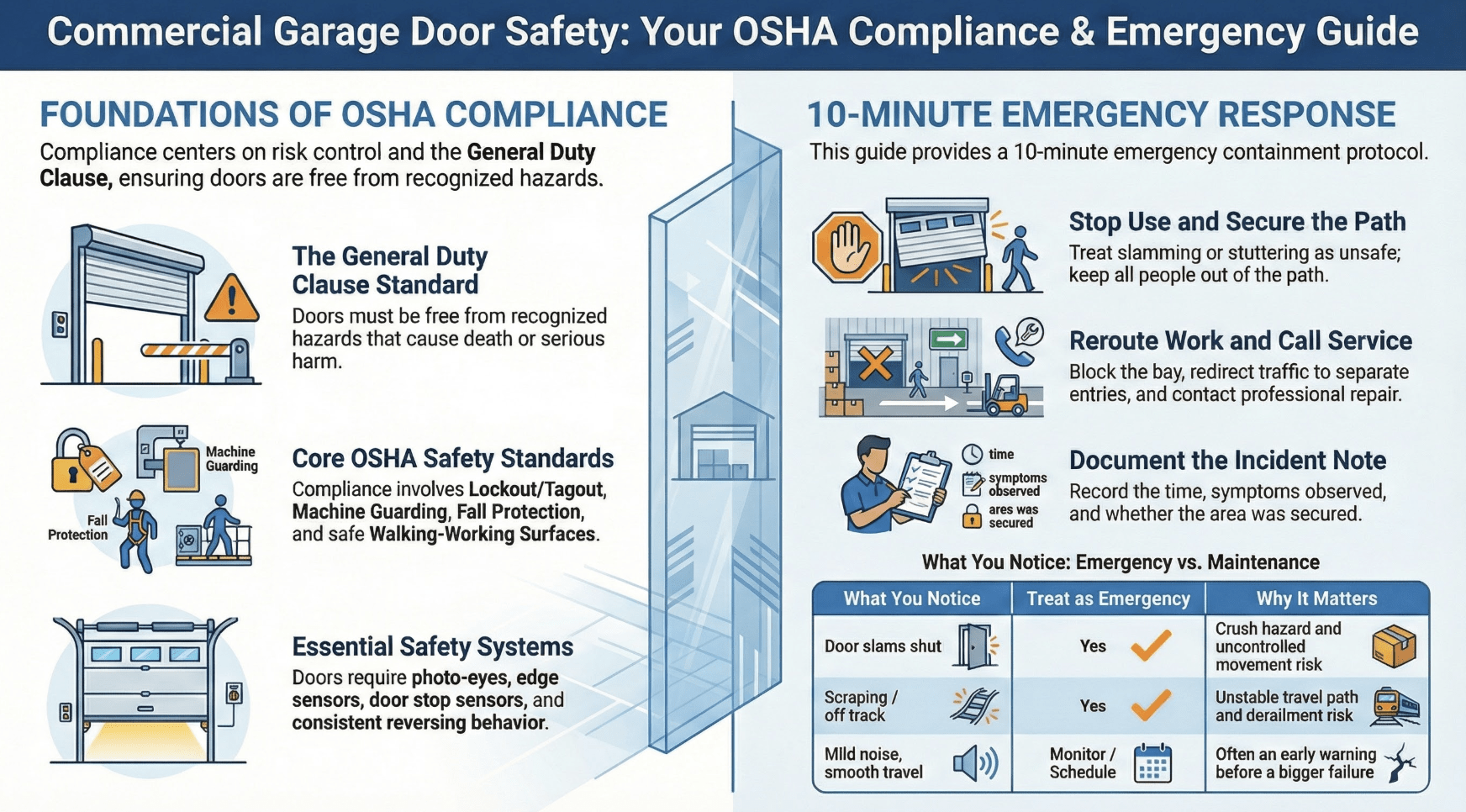
Overhead garage doors are subject to OSHA compliance standards, specifically Section 5(a)(1) of the Occupational Safety & Health Act of 1970. Employers must ensure that overhead doors are free from recognized hazards that could cause death or serious physical harm to employees.
Raynor Door Authority supports facilities with emergency commercial door repairs and service that help stabilize the bay quickly and get your operation back to a safer baseline.
1. The Door Can’t Be a Known Injury Hazard During Normal Operations
A commercial bay door is essentially a moving wall, so OSHA-compliant starts with the door not being a predictable injury hazard during normal operations. If it is slamming, bouncing, jerking, or drifting out of alignment, OSHA expects the risk to be corrected, as those failure patterns can lead to serious harm.
In day-to-day terms, a safer door is one that travels smoothly without sudden drops or violent reversing, keeps tracks, rollers, hinges, and bottom fixtures stable under load, and has safety systems such as photo-eyes, edge sensors, exit points, safety devices, safety device edge, and door stop sensors, along with reversing behavior that works consistently.
The absence of safety device edges or door stop sensors on overhead doors can lead to unacceptable exposure to crushing or struck-by hazards, potentially resulting in serious physical harm or physical harm, especially to anyone underneath the door.
2. Pedestrians Aren’t Walking Through Active Bay Doors
The next practical expectation is traffic control around the opening. One of the simplest, highest-impact changes is keeping pedestrian traffic out of the active bay-door lane.
In loading zones, forklifts and pallet traffic move quickly through that opening. When people cut through the same space, it creates avoidable struck-by and caught-between exposure, especially during rush periods, poor weather, or low visibility.
OSHA-friendly control usually means routing foot traffic through a door whenever possible, using clear signage to define the bay door opening as a vehicle lane, and marking pedestrian routes so they do not overlap with forklift paths.
3. Damaged Doors Get Taken Out of Service Fast
A third signal of strong safety practice is how quickly damaged doors are taken out of service. In commercial settings, dealing with it later often brings problems. Responsible handling includes proper maintenance and maintaining safe conditions: if the door is unsafe or unstable, stop using it, block off the bay until repairs are completed, and prevent vehicles from pushing through a door that is not operating correctly.
Neglected garage doors become less reliable and potentially more hazardous over time.
This is the kind of recognized hazard that can raise OSHA exposure under the General Duty Clause when it is allowed to remain in service.
4. Repairs Happen Under Controlled Conditions
Repairs also need to happen under controlled conditions because commercial door systems involve stored spring energy, powered operators, and heavy moving sections. A safe repair scene is one where the work area is secured so nobody walks under or around active work. It is essential that garage doors are properly constructed and that only qualified professionals install or repair these systems to ensure OSHA compliance and prevent safety hazards.
Employers are advised to hire professionals to install safety devices and conduct periodic inspections of overhead doors. Overhead doors must be adequately constructed and adjusted to prevent hazards.
Controls should also be disabled appropriately, and hazardous energy must be managed during servicing when required. This is where the principle behind OSHA’s Control of Hazardous Energy standard (Lockout/Tagout) becomes practical: if equipment could unexpectedly energize or move, it must be controlled before someone works in the hazard zone.
5. The Facility Can Show It’s Managing the Risk (Even Without an Incident)
Finally, facilities reduce risk when they can show they manage overhead doors as a system, with proper documentation, business-focused processes, and a strong emphasis on compliance, even if no incident has occurred.
Documentation should detail maintenance and service work performed on overhead doors, and documentation of maintenance and safety compliance should be thorough and secure.
If OSHA ever asks what you are doing to prevent door-related incidents, the strongest answer is evidence.
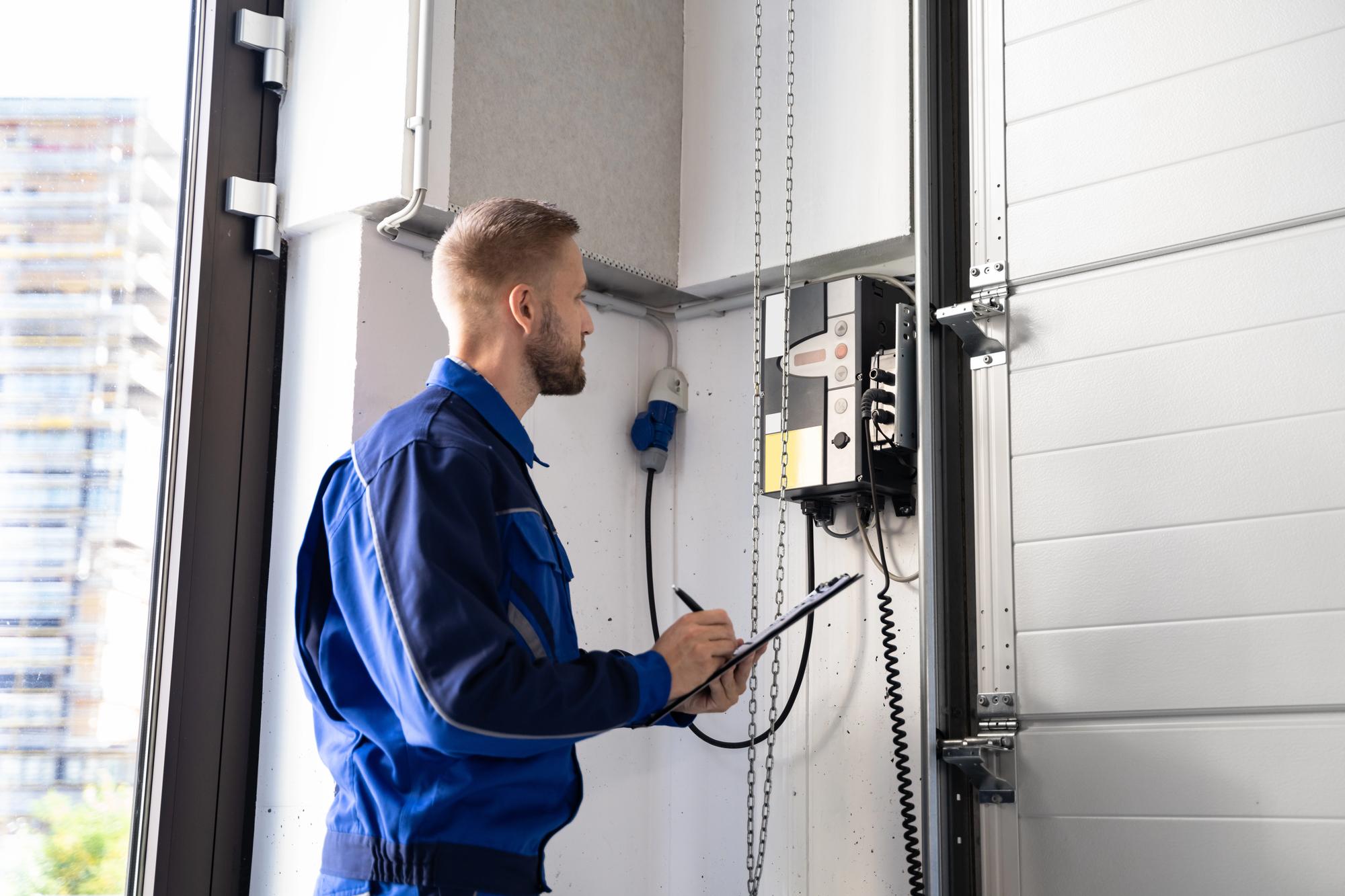
OSHA Rules That Commonly Show Up in Emergency Commercial Door Repairs
OSHA citations tied to overhead and roll-up door incidents often reference broader safety standards, especially around energy control, safe walking surfaces, fall exposure, and moving pinch points.
OSHA requirements, along with other applicable regulations and industry standards, govern the safe operation, maintenance, and inspection of commercial garage doors. When manufacturer specifications are unavailable, industry standards such as those from DASMA should be followed to establish proper maintenance practices and intervals.
Below are the OSHA rules that most commonly show up in commercial emergency garage door repair situations, along with what they mean in day-to-day facility terms.
1. Control of Hazardous Energy (Lockout/Tagout) – 29 CFR 1910.147
This standard is intended to prevent a machine or piece of equipment from starting unexpectedly or releasing stored energy while someone is working on it.
During repair, OSHA typically wants to see that the door is fully controlled before work begins, meaning it’s not possible for the operator to engage the door or for the system to move unexpectedly while a technician is in the hazard zone.
2. Walking-Working Surfaces – 29 CFR 1910.22
29 CFR 1910.22 focuses on walking-working surfaces and the expectation that floors be maintained in a clean, dry, and safe condition for use.
In practical terms, it pushes facilities to treat floor conditions as a core safety responsibility, not an afterthought, because slip-and-fall risk rises quickly when moisture, ice, or debris is allowed to build up.
3. Fall Protection – 29 CFR 1910.28
29 CFR 1910.28 addresses fall protection when workers are exposed to fall hazards, especially during tasks performed at height where a slip or misstep could cause serious injury.
Commercial garage door work often involves elevated tasks, such as adjusting tracks on taller doors, servicing operators mounted higher up, or making repairs near dock edges and raised surfaces.
In simple terms, if a repair requires working at height, OSHA expects proper fall protection practices that match the work environment.
4. Machine Guarding (General Requirements) – 29 CFR 1910.212
29 CFR 1910.212 covers machine guarding and the need to reduce exposure to hazards created by moving mechanisms, including pinch points, nip points, rotating parts, and components that can catch clothing or hands.
In commercial garage door systems, these risks can appear around hinges and rollers, tracks and guides, and operator systems such as chain drives, as well as in any area where door travel creates a trapped zone.
How to Handle a Commercial Garage Door Failure in 10 Minutes
When a commercial garage door starts acting up, the goal in the first few minutes is not diagnosis. It’s containment. A door that’s jerking, slamming, or drifting off-track can turn into a struck-by or caught-between incident fast, especially in busy bays where forklifts, pallet jacks, and foot traffic overlap.
These quick steps help your team stay calm, reduce risk, and get the right help on the way without creating more damage.
Immediate steps your team can take
- Stop using the door immediately if movement feels off. If the door is slamming, stuttering, scraping, or reversing unexpectedly, treat it as unsafe equipment. Continuing to cycle is how small failures become bigger repairs.
- Keep people and vehicles out of the door’s travel path. That includes the full opening, both sides of the tracks, and the floor area where the door lands. It is not only about the door falling, but also the risk of pinch points and sudden movement.
- Secure the area and reroute work. Block the bay, redirect foot traffic to a separate entry, and, if possible, move loading to another lane. A simple reroute buys you time and reduces exposure while the situation is being handled.
- Call for service and describe symptoms clearly. Skip general descriptions. Better details help dispatch the right technician and parts. Share what you see and hear.
- Start a quick internal incident note.
This is helpful for shift handoffs, safety records, and vendor follow-up. Keep it simple:
- Time noticed
- Who reported it
- Symptoms observed
- Whether the area was secured
- Who was called
Stop Use vs. Keep Monitoring
| What you notice | Treat as an emergency | Why it matters |
|---|---|---|
| Door slams shut / won’t stay open | Yes | Crush hazard and uncontrolled movement risk |
| Loud popping near the spring area | Yes | Spring failure risk can escalate quickly |
| Scraping / door off track | Yes | Unstable travel path and derailment risk |
| Water pooling at the threshold | Usually yes | Slip hazard, corrosion risk, and sensor problems |
| Mild noise, door still smooth | Monitor + schedule service | Often early warning before a bigger failure |
If the door affects safety, workflow, or access control, the smartest move is to treat it like an operations stop, secure the area, and bring in professional repair support fast.
Keep Your Operations Moving With Raynor Door Authority
In a commercial setting, an emergency door issue is rarely just a door problem. It can stall shipments, block equipment access, and create real safety exposure in a high-traffic work zone.
The safest approach is to treat the first signs seriously, secure the area fast, and get professional help before a minor failure turns into downtime or injury risk.
Next 3 steps to take:
- Secure the door zone immediately by stopping operation, clearing foot traffic and vehicles, and rerouting workflow to another entry if needed.
- Document what’s happening in simple terms (time, symptoms, who reported it) so your team stays aligned and the repair tech can respond faster.
- Call Raynor Door Authority for 24/7 emergency service to handle urgent repairs like broken springs, off-track doors, cable issues, roller and hinge replacements, and opener or sensor problems.
Contact your local Raynor Door Authority now to get emergency repair support and restore safe, reliable door operation as quickly as possible.