


Fall Garage Door Maintenance Checklist Before the First Freeze
Key Takeaways
1. Cold weather rarely breaks a healthy garage door, so fall maintenance is really about finding the wear that, in winter, turns into a failure.
2. A homeowner checklist ends with balance, safety reversal, seals, fasteners, and lubrication, because springs, cables, and opener force settings are the domain of a trained technician.
3. Raynor Door Authority has serviced doors and openers as one system for over 40 years, so a scheduled fall tune-up replaces an emergency call in January.
The 10-Minute Fall Garage Door Maintenance Checklist You Can Do Yourself
Cold weather does not cause garage door failures; it exposes those already forming. A spring near the end of its life, a dry roller bearing, or a cracked seal will all survive a mild October and quit on the first cold morning, which makes fall the last cheap window to catch them.
Work with the door closed unless a step says otherwise, and keep people clear of the opening. DASMA’s fuller inspection checklist takes about 15 minutes.
Pull the Manual Release and Test Your Garage Door Balance
With the door fully closed, pull the red manual release cord and lift the door by hand. Never pull it while the door is open, because a door with a failing spring can drop hard enough to cause injury.
DASMA’s checklist asks two questions. Does the door stay fully open, and does it hold still when left partly open 3 to 4 feet above the floor? A door that drifts, slams, or fights you needs a spring adjustment, which is a single visit for a Raynor Door Authority technician and not a homeowner’s job.
Reverse Test Your Garage Door Safety Sensors
Run both entrapment protection tests, since they check different systems.
- Beam test. Start the door closing, then wave a broom handle through the photo eye beam. The door should stop and return to the fully open position.
- Contact test. Lay an object about an inch and a half tall, such as a 2×4 laid flat, under the center of the opening. The door should reverse on contact.
- Height check. DASMA puts the beam no higher than six inches off the floor, and the Consumer Product Safety Commission’s safety alert says 4 to 6 inches.
The CPSC asks for this inspection every 30 days, not once a season. If either fails, photo eye alignment is worth a look, but stop using the opener and book a repair rather than working around it.
Check the Garage Door Bottom Seal for Gaps and Cracking
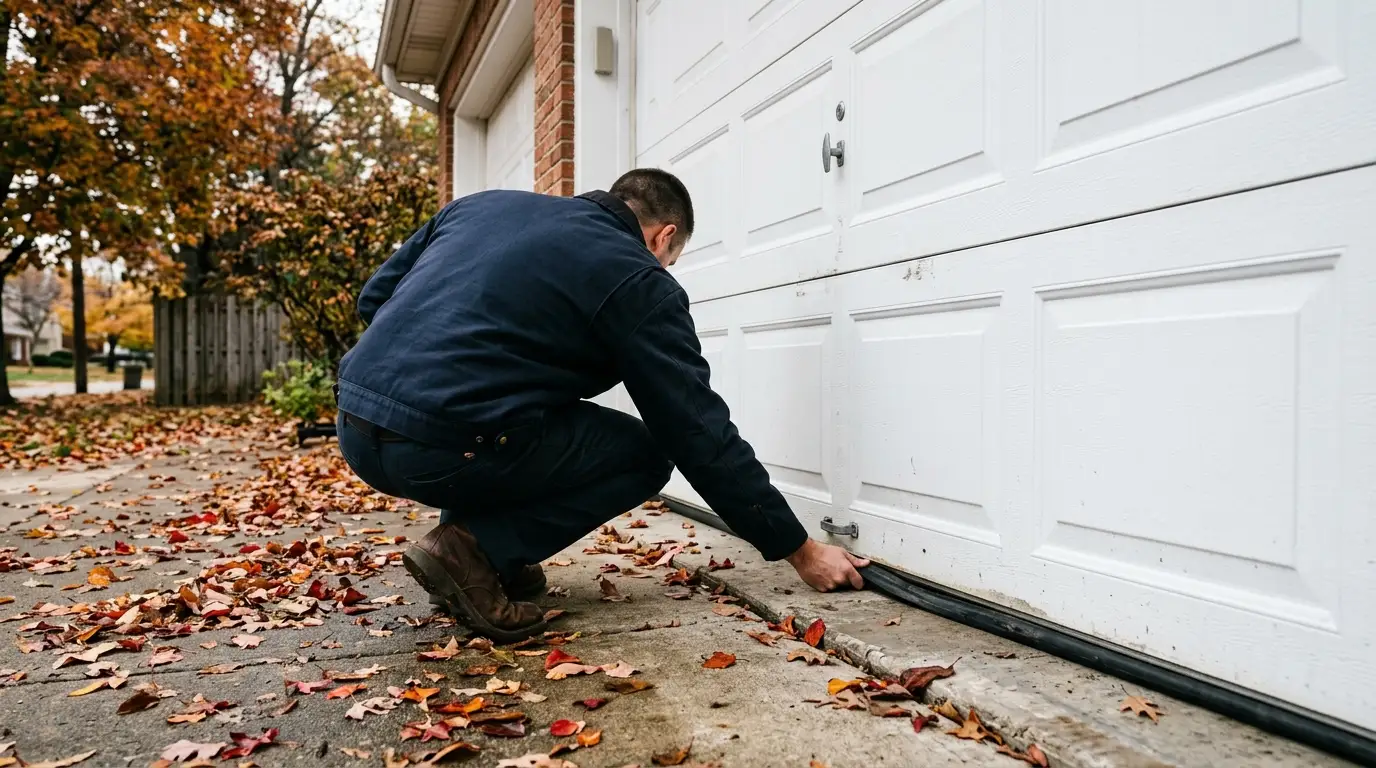
Close the door, look along the floor line for daylight, then press the seal with your hand. A healthy bottom seal is pliable and springs back. One that feels stiff, crumbles, or shows signs of splitting needs a garage door seal replacement before the first freeze, not after.
A gap at one corner usually means the slab is not level, and a threshold seal fixes that better than new weatherstripping. Either way, it is the same-visit work, so bundle it with a tune-up rather than paying for two trips. If the door freezes shut each winter, forcing it open is an expensive mistake.
Tighten Loose Garage Door Hinges and Track Brackets
A door opened four times a day cycles roughly 1,460 times a year, and that vibration backs fasteners out. Run a socket wrench over the hinge bolts between sections and the fasteners holding the track brackets to the framing. Snug is the target, not tight, since the steel is thin and stripped threads turn a five-minute job into a parts order. Leave every red fastener and both bottom brackets alone.
Clean and Lubricate the Right Garage Door Parts
Care instructions require lubrication every six months to maintain the warranty and name the product. Use a silicone or Teflon-based spray.
Treat the hinges, the roller bearings and shafts, the spring shaft, the end bearings, and the spring itself. Spraying a spring is fine. Winding, loosening, or adjusting one is a technician’s job. Wipe the tracks clean rather than greasing them, since rollers should roll, not slide.
Listen for the Three Sounds That Mean Stop Using Your Garage Door
Most garage door noise is a maintenance item. Three sounds are not.
- A single loud bang. This is usually a torsion spring letting go. DASMA is blunt about what follows: do not operate the door until it is replaced.
- Grinding or scraping. Metal-on-metal points to a failed roller bearing or a misaligned track, and running the door spreads the damage.
- A sharp pop from one side. A cable or bracket under load has shifted, causing the door to travel crookedly.
All three mean stop using the door and call for service, not monitor it.
Which Garage Door Parts Should You Never Touch Yourself?
Anything carrying the weight of the door. DASMA opens its homeowner safety advice with the reason: a garage door is the largest moving object in the home.
| Component | Why Adjustment Is Off-Limits |
|---|---|
| Torsion springs | Wound under high tension and released only with winding bars and training. A slip transfers all of it at once. |
| Cables and drums | Loosening a drum-set screw instantly drops the door’s weight. |
| Bottom brackets | Bolted to the cable under a full share of the load. DASMA warns homeowners not to loosen these, red fasteners, or cables. |
| Opener force and travel limits | Raising the force to push through friction defeats the protection that stops the door on contact. It hides the symptom and adds risk. |
What Does a Professional Fall Garage Door Tune-Up Cover?
The checklist above stops where the stored tension starts. Everything below is what a technician covers on the same visit.
- Hardware and fasteners. Hinges, brackets, and the operator’s connections to the door and wall checked for wear and tightness.
- Spring cycle count and balance. One cycle is a full open-and-close, per the ANSI/DASMA sectional door standard. Standard springs are rated for approximately 10,000 cycles, roughly 6.8 years at four cycles a day and 3.4 at eight cycles a day.
- Rollers, hinges, and bearings. Wobbling rollers and worn end bearings are cheap now and expensive once they take the shaft with them.
- Track alignment. Sections checked for plumb, spacing, and dents that pinch a roller mid-travel.
- Opener safety and force. Garage door opener maintenance is more than a battery. Both reversal systems get tested and the limits verified.
- Weatherstripping and threshold. The bottom seal, the stop molding, and the floor are judged together.
The Complete Guide to Garage Door Maintenance
What Cold Weather Does to Garage Door Springs, Seals, and Lubricant
Cold increases friction throughout the system at once, which is why a door can feel fine one week and struggle the next.
- Thicker lubricant. Whatever is on the hinges, roller bearings, and spring shaft gets more viscous as temperatures drop, so parts that turned freely in September drag.
- Stiffer seals. Vinyl and rubber lose flexibility, and a seal that was merely cracked stops meeting the floor evenly.
- Trapped moisture. DASMA’s data sheet on spring cycle life explains that rust cuts the spring wire’s effective area and opens corrosion pits where fatigue cracks start.
- A harder-working opener. A force setting that was correct in August starts reading normal travel as an obstruction.
Which Garage Door Failures Happen at the First Hard Freeze?
Four failures account for most first-freeze service calls: a broken spring, a door frozen to the slab, misaligned photo eyes, and an opener that reverses partway down.
- Broken torsion spring. It goes on the morning when the door is the heaviest to lift.
- The door is frozen to the slab. Water pooled under a worn seal and refroze overnight.
- Misaligned photo eyes. A season of condensation and knocks pushes the beam out of line.
- Opener reversing partway down. Friction passed what the force setting allows.
Only the frozen door needs the cold itself, and even that one needs a worn seal to let the water in. The other three were set up in autumn while nobody looked.
Signs Your Garage Door Needs Service Now, Not in Spring
Some symptoms can wait for a scheduled visit. These cannot, and each means to stop using the door.
- Uneven or crooked travel. One side leading the other points to a cable or drum problem that worsens every cycle.
- A visible gap in a spring. The spring is broken, and the door is now heavier than it looks.
- Frayed cable strands. Lift cables fail gradually, then all at once.
- A door that will not hold position. Disconnected from the opener, it drifts or drops instead of staying put.
After hours, emergency repair beats another test cycle. If the motor runs but the door does not move, the fault sits inside the opener, not the counterbalance.
How Often Does a Garage Door Need a Professional Tune-Up?
Once a year for most households, plus a short homeowner check every 30 days. Our warranty terms set the baseline: lubricate every six months; inspect springs and hardware every twelve months.
| Household | Typical Daily Cycles | Recommended Service |
|---|---|---|
| Standard use, one or two drivers | 2 to 4 | Annual tune-up, monthly safety test |
| High-cycle or multi-driver homes | 6 to 10 | Tune-up every 6 to 12 months, with a spring assessment |
| Coastal, dusty, or extreme temperature | Varies | Annual tune-up plus Raynor’s washing and waxing steps |
How Raynor Door Authority Handles Your Fall Garage Door Tune-Up
A garage door and its opener are one system, and most cold-weather failures start on the door side. That is the part homeowners cannot safely check, so it is where a Raynor Door Authority visit begins.
- Certified technicians. Our teams train on safety standards and entrapment protection, not only parts replacement, and our Rockford branch has been named to the International Door Association’s Top 100 dealer list.
- All-inclusive pricing. You get the findings and a clear quote up front, including an honest answer on what is worth replacing.
- 24/7 emergency response. If something fails at 5 a.m. in February, round-the-clock service is available.
What You Should Do Next to Winterize Your Garage Door
Fall maintenance costs about ten minutes today and saves far more in repairs. Work in this order.
- Disconnect the opener with the door closed, test the balance by hand, then run both reversal tests and check the photo eye height.
- Inspect the bottom seal, tighten the visible hardware, and lubricate with a silicone or Teflon-based spray. Stop if you find a gap in a spring, a frayed cable, or a door that drifts.
- Contact your nearest Raynor Door Authority location to book a tune-up before the first freeze fills the schedule.
FAQs