


When Do You Need a Garage Door Bottom Seal Replacement?
Key Takeaways
1. Replace a garage door bottom seal once it is cracked, stiff, flattened, shrunken, or chewed, which in our experience takes three or more years.
2. A gap that tapers to one side, runs under a still-soft seal, or sits over one low spot usually starts with the door, opener, or floor.
3. At Raynor Door Authority, our technicians check the seal, retainer, balance, and opener settings together, so one garage door inspection can pinpoint the real source of the gap.
How Do I Know if My Garage Door Bottom Seal Is Damaged?
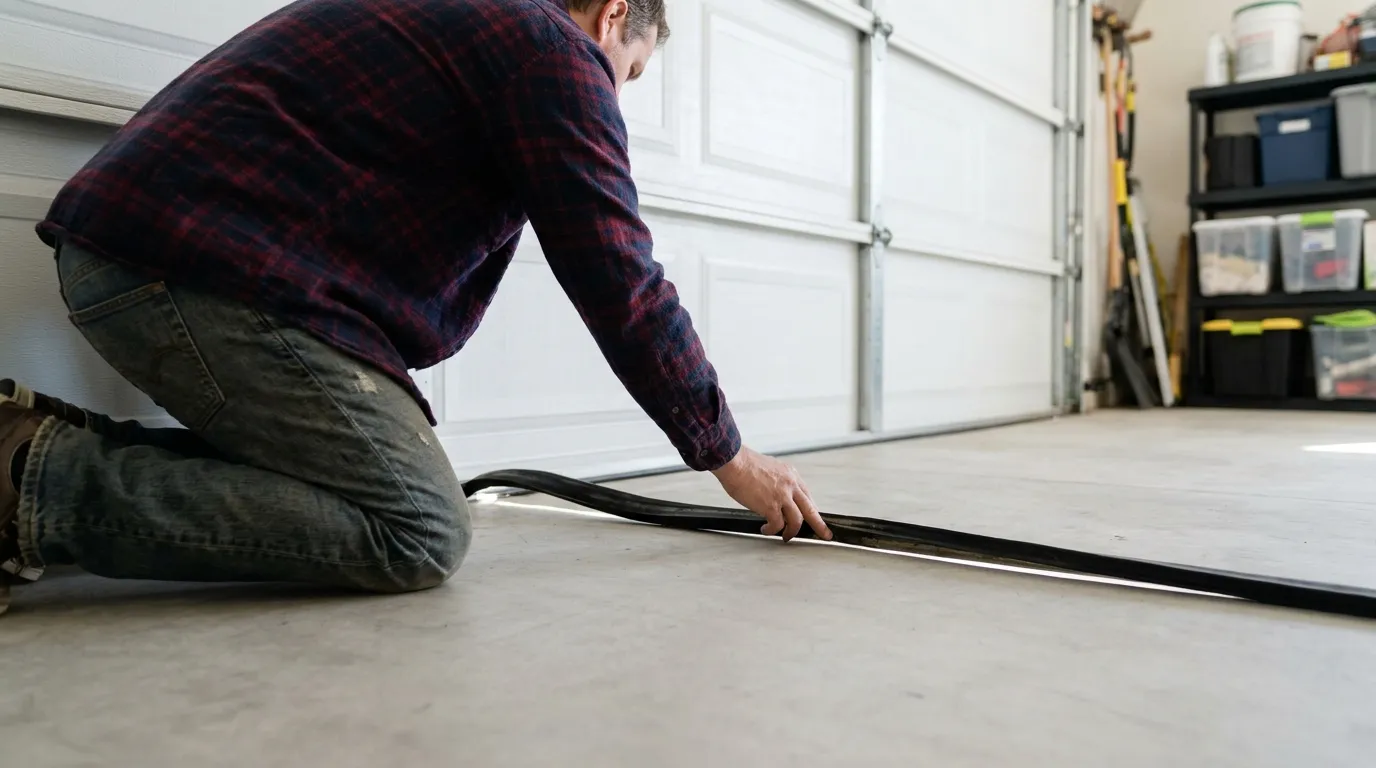
Your bottom seal is damaged if you can see daylight under the closed door, or if the rubber feels stiff, cracked, flattened, or chewed. A quick daylight test will show you which.
- Close the door and look along the floor line from inside on a bright day with the lights off. Note exactly where light shows.
- Squeeze the seal every few feet. Healthy rubber springs back, while stiff, crumbly, or flattened rubber has aged out.
- Check both ends for gnaw marks or a seal that stops short of the door edges.
- Confirm the door rests on the floor. The Door and Access Systems Manufacturers Association (DASMA) inspection checklist treats any gap there as a failed check.
Signs Your Garage Door Bottom Seal Has Failed
These are the signs we look for first:
- Daylight or drafts at the floor line with the door closed.
- Water, leaves, or dirt blowing in under the door.
- Cracked, stiff, or flat rubber that doesn’t spring back.
- Seal ends that stop short of the door edges.
- Gnaw marks near the bottom corners.
Any one of them usually means a garage door bottom seal replacement is due.
Age matters too. Chris Farr, a garage door technical expert at Raynor Door Authority, gives a rough benchmark,
“I’d say on average a bottom seal remains good for 3+ years, but different factors can make that much shorter or longer.”
Those factors include climate and exposure, the type of seal, rodents, and physical damage. In our markets, hard freezes stiffen vinyl and can bond a wet seal to the slab, while cars, shovels, or anything left under the door can tear it.
Not every gap means a bad seal, though. If the rubber still looks and feels healthy, the gap usually starts with the door, the opener, or the floor.
Does a Damaged Garage Door Bottom Seal Have to Be Replaced?
Not always. Small problems can be fixed, but most worn seals are better off replaced.
A seal that has slipped out of its retainer track can usually be pushed back into place. A short gap or small tear near one end can sometimes be trimmed or patched, but only if the rest of the rubber is still soft and flexible.
Replace the seal if the rubber is stiff, cracked, flattened, or crumbling along most of its length. Aged rubber won’t spring back, so a patch won’t hold.
Replace it if daylight shows under a wide section of the door. A gap that size lets in rain, drafts, and pests.
Replace it if mice or other pests have chewed through it. They will use the same opening again.
Bottom seals are inexpensive and quick to install. A patch on old rubber tends to fail within a season, and then you are doing the job twice.
If you’re not sure which category yours falls into, a technician can tell in a few minutes. If your door is made by Raynor, we can also match the seal to your door’s bottom retainer so it fits the first time correctly.
When Do You Need to Call a Garage Door Technician for Your Broken Garage Door Seal?
Stop the moment the job moves beyond rubber.
- A bent, torn, or rusted retainer. On many doors its ends meet the bottom corner brackets, which anchor the lift cables under spring tension.
- A rusted-through or rotted bottom section. A seal can’t grip a crumbling edge, though we can often replace that one section instead of the whole door.
- A door that won’t hold position or hangs crooked. That’s spring and cable work.
- A failed reversal test or any opener adjustment. Leave the opener disengaged and let a technician handle it.
Any of these calls for one of our seal and balance inspections.
What Caused the Gap Under Your Garage Door?
| What You See | Likely Cause | First Fix |
|---|---|---|
| Full-width light, cracked or flat seal | Worn seal | Replace the seal |
| Seal stops short of the door edges | Old seal shrank or crept | Replace it, sized to the door |
| Chewed corners, droppings nearby | Mice | New seal with metal edge protection |
| Torn sections after a cold snap | Seal froze to the floor | Replace it, keep the floor dry |
| Full-width light, soft seal | Opener stopping short, or seal too small | Technician check |
| Tapered gap, or open corners under a full seal | Crooked door or uneven floor | Level check, then a technician |
| Gap over one low spot | Dip in the slab | Threshold seal or concrete repair |
If It’s Not the Bottom Seal, Why Is There a Gap Under My Garage Door?
A crooked door, an opener that stops short, an uneven slab, and outside drainage can all mimic a failed bottom seal. Drafts also sneak past worn side and top stop molding or through an uninsulated door, so a new seal alone won’t warm a cold garage.
An Uneven Gap Usually Means the Garage Door or Floor Isn’t Level
A gap that tapers from nothing at one end to a finger’s width at the other usually means the slab has settled or the door hangs crooked. A bent bottom section can cause it too. Hold a level on the floor along the door line, then against a section joint, for a first clue about which one is off.
A crooked door often points to a lift cable, drum, or torsion spring problem, and DASMA’s checklist tells homeowners not to adjust any of them. Farr has seen homeowners unbolt the bottom corner bracket to level a door while its cable is still under tension. “Once the fasteners are removed, it would be similar to releasing the string on a bow and arrow,” he says.
A thicker seal only hides the tilt, so we level the door before fitting the seal.
A Full-Width Gap With a Soft Seal Often Points to the Garage Door Opener
If the seal still squeezes like new but light spans the whole opening, the opener is a common suspect. Its close limit, one of the opener travel settings, can drift with temperature swings. A seal too small for the gap, or a slab settled across the opening, can look the same.
We’d leave travel and force adjustments to a technician, because a wrong setting can keep the door from reversing. You can lay a 2×4 in the door’s path, as the Consumer Product Safety Commission (CPSC) garage door safety alert advises, and disengage the opener if the door doesn’t reverse.
If it fails the test, contact your nearest Raynor Door Authority location, and we’ll inspect the opener before you use the door again.
Water Coming Under the Garage Door Is Often a Drainage Problem
A bottom seal won’t stop every drop. DASMA’s guidance on water under sectional doors calls rainwater getting past the bottom edge “a common occurrence.” Its fixes start in the concrete, with a slightly sloped lip or a slab notch the door rests in.
If water flows to the door from outside, regrading or a trench drain beats any seal. Under Section R401.3 of the 2021 International Residential Code, the ground must fall at least 6 inches within the first 10 feet from foundation walls.
Where lot lines or other barriers prevent that, the code requires drains or swales, and paved surfaces within 10 feet must still slope at least 2% away. Local codes can amend both rules.
What Is the Best Garage Door Seal to Keep Mice Out?
The best garage door seal to keep mice out is a rodent-resistant bottom seal with stainless steel mesh built into the rubber. We recommend it because University of Nebraska-Lincoln Extension’s rodent-proofing guidance warns that rodents can quickly gnaw through plain rubber and vinyl.
House mice can squeeze under a gap just 1/4 inch tall, according to University of California pest guidance.
In the Census Bureau’s 2021 American Housing Survey, 15.3 million of 128.5 million occupied U.S. homes, nearly 12%, reported signs of mice or rats inside during the previous year.
Beyond the seal, we’d take these steps:
- Add metal guards to the bottom corners of the door, where the seal ends are exposed.
- Keep the side and top seals tight, since mice also use gaps along the jambs.
- Plug small openings around pipes and vents with steel wool packed in caulk.
- Store pet food and birdseed in sealed containers so the garage offers nothing to eat.


Superior Doors. Expert Service.
Your trusted garage door experts for residential and commercial properties. Premium products, expert installation, fast repairs, and dependable service that keeps your home secure.
Expert ServiceSince 1971
How Do You Replace a Garage Door Bottom Seal Yourself?
To replace a garage door bottom seal yourself, disconnect the opener, slide the old rubber out of its retainer, feed in a matching seal, and retest the door. That’s the one bottom-seal job we’d leave to homeowners, and only on a steel door that holds its position and hangs level.
Wood-door seals and anything involving springs, cables, or opener settings belong with a technician, so book a repair inspection with our team.
Match the Retainer Before Buying a Replacement Garage Door Bottom Seal
Bottom seals aren’t universal, and a mismatched profile is where a lot of garage door seal replacement jobs stall.
- The T-end size. Slide a few inches of the old seal out and measure the edges that lock into the channel, since the common 1/4-inch and 5/16-inch T-ends aren’t interchangeable.
- The profile. Some retainers take bulb or bead edges instead, so bring a cut sample when you shop.
- The length. Measure the door, not the old seal, since aging vinyl can shrink and leave the corners open.
- The material. Vinyl costs less but stiffens in hard cold, while EPDM, a synthetic rubber, stays pliable.
Steps for Swapping a Garage Door Bottom Seal in an Intact Retainer
- Disconnect the opener with the door closed. Pull the red release cord and unplug the unit. Never pull the cord with the door open.
- Raise the door by hand to about 3 or 4 feet, with fingers clear of the section joints. A balanced door holds there on its own, the same check DASMA uses. If it feels heavy, drifts, or drops, stop and call a technician.
- Clamp locking pliers to each track just below a roller so the door can’t roll down, and keep your head out from under it.
- Pull out the old seal. Open crimped ends or remove the retainer’s end plugs or screws, never the bottom bracket bolts, then slide it out and brush the channels clean.
- Feed in the new seal. Mist the T-ends with silicone spray or soapy water, then feed from one end while a helper pulls. Trim the excess and crimp or plug the ends.
- Reconnect and retest. Remove the pliers, lower the door, reattach the opener, and rerun the 2×4 reversal test, since a fuller seal changes where the door meets the floor. If the door fails or won’t seal evenly, disengage the opener and call a technician.
Do You Need a Garage Door Threshold Seal or a Better Bottom Seal?
Add a garage door threshold seal when the floor is the problem, and replace the bottom seal when the rubber is. A threshold is a strip glued to the floor that gives the bottom seal a raised edge to land on.
| Feature | Garage Door Bottom Seal | Garage Door Threshold Seal |
|---|---|---|
| Where it mounts | Retainer on the door’s bottom edge | Floor, under the closed door |
| Best for | Worn rubber, small even gaps, drafts | Dips at the door line, wind-driven rain |
| Weak spot | Can’t bridge a crooked door | Can trap meltwater, and adhesive can loosen under tires |
A threshold’s real weak spot is drainage. The same code, in Section R309.1, requires a garage’s parking area to slope so liquids move to a drain or toward the main vehicle entry doorway. A threshold blocks that exit.
If you park snowy cars inside with no floor drain, plan for that water before gluing anything down. Otherwise, you may trade a leak for a door frozen to the floor. A threshold also raises the closing point, so have the opener’s close limit checked and rerun the 2×4 test.
The Complete Guide to Garage Door Maintenance
How We Handle Garage Door Bottom Seal Replacement at Raynor Door Authority
At Raynor Door Authority, we’ve serviced garage doors for more than 50 years in cold-winter markets across the United States and Canada.
- Seal and retainer replacement. Our technicians handle the weather seal repair work a DIY swap can’t, including bent or corroded retainers.
- The cause behind the gap. We check balance, cables, and opener limits too, so a crooked door gets fixed instead of disguised.
- 24/7 emergency service. A door frozen to the floor or stuck open overnight gets round-the-clock help.
What You Should Do Next
- Run the daylight test with the lights off, squeeze the seal, and note where the gap sits.
- Match the fix to the cause. Swap a worn seal in a sound retainer yourself, and leave metal parts, balance, and opener settings to a technician.
- Contact your nearest Raynor Door Authority location, and we’ll inspect anything the test turns up.
FAQs